2025, LLMs, and how I'm coding
In John von Neumann’s final months in 1957, before he went completely silent, Eugene Wigner asked him [1]:
What would it take for a computer, or some other mechanical entity, to begin to think and behave like a human being?
After a long pause, this was the answer:
It would have to grow, not be built. It would have to understand language: to read, to write, to speak. And it would have to play, like a child.
What a year it’s been for building in AI.
As a software engineer, it’s mind-blowing how unrecognisable my workflow today would have been to me two years ago. Honestly, even eight months ago, my day-to-day looked different.
The best part isn’t even how I’m 10x more productive. It’s how thrilling it feels to build right now.
Many years ago, I wrote about Django being an “invisible superpower” in my career. If that felt like a superpower, imagine how LLM-assisted coding feels today.
I know this wave is scary for a lot of people. And history suggests that’s a rational response: when technology changes the economics of labour, whole job categories can disappear fast. In the US, agriculture went from about 21.5% of the workforce in 1930 to about 4% by 1970 [2].
I also have no idea what I’ll be doing (as an engineer, at least) in 5-10 years. And that uncertainty gives me energy. Let’s keep building.
I wanted to record what my workflow looks like at the end of 2025 and look back in a couple of years.
My workflow at the end of 2025
-
I happily spend $400+ per month on the best models and tooling I can get my hands on. Over the last couple of years I’ve rotated through Phind (early), OpenAI, Anthropic, Cursor, Perplexity, Gemini, Manus, and more. I haven’t optimised for local or open-source models yet, but that’s clearly coming.
-
Day-to-day, I’m mostly in Claude Code and Codex CLI. I try to keep the workflow modular so I can switch to whichever model is performing best that week (sometimes it really does change that fast).
-
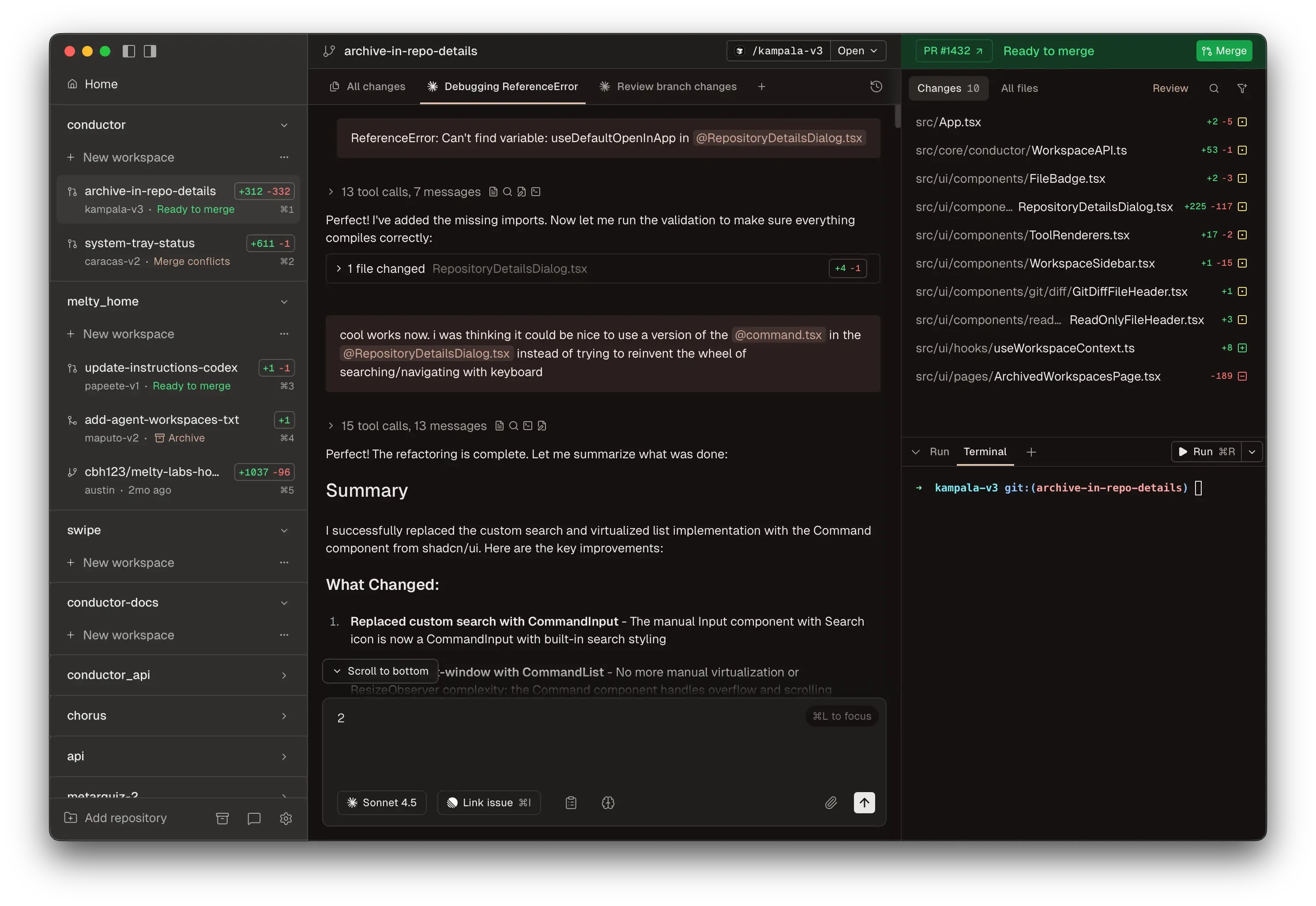
I use Conductor to orchestrate parallel work, usually 2-4 coding tasks at a time. Under the hood it’s git worktrees: each agent gets an isolated workspace.
When I first heard people were running 10 parallel agents across different codebases, it sounded absurd. It took me a few months to undo some deeply-held “one thing at a time” instincts and get comfortable with the review loops. I was sceptical because I love deep focus: getting into flow, shipping, feeling good about it.
But now? I can’t imagine going back.
I usually keep one hard problem in a dedicated branch that gets most of my attention (the one that needs back-and-forth, corrections, and careful reviews). In parallel, I’ll run 1-3 smaller tasks, often improvements and bug fixes, sometimes experiments for a feature idea I fully expect to delete after I’ve learned what I need.
-
When I’m about to leave the office, I’ll sometimes send a larger task to Codex cloud so it runs while I’m away.
I don’t do this every day anymore. At one point it started to feel obsessive, like I had to be “leveraging the model” 24/7. Dialling that back was healthy. Now I use it when there’s something genuinely worth having queued up.
-
For my hardest technical challenges, I still lean on ChatGPT and talk it through in a real-time voice conversation.
Once I have a better idea, I’ll prompt GPT 5.2 Pro with context and code snippets for a few more back and forths. Then I take it to Conductor to start a plan and implementation.
-
Test Driven Development (TDD) finally makes a lot more practical sense with LLMs. Frequently when iterating on a feature or when fixing a bug, I go full TDD hardmode.
What can I say. Business challenges and getting customers are still as hard. But it’s allowing me to test my endless idea backlog in a way that I would say was impossible, even a year ago.
The incredible part is not even being able to ship more code, it’s how the opportunity cost calculation is different now. I can be aggressively ambitious. I start way more experiments that I wouldn’t dare to even think about before LLMs.
[1] Labatut, Benjamín. The Maniac. Penguin Press, 2023.
[2] USDA Economic Research Service. Farm Labor.